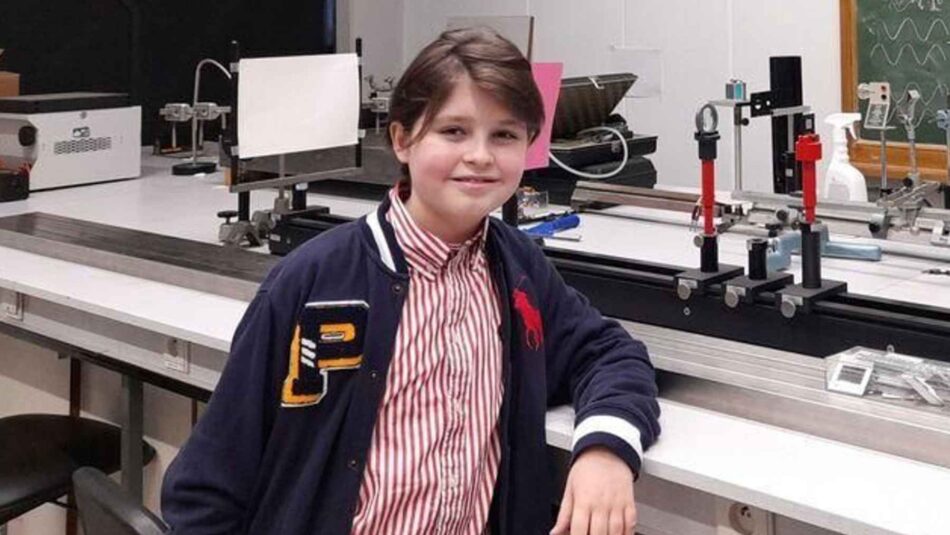
A young man aged just 15 is about to officially become a doctor of quantum physics in Antwerp, and what is most surprising is that he already lives in Munich, where he is preparing a second doctorate focused on medicine and artificial intelligence
- Understand the rapid academic progress of a prodigious young physicist bridging quantum physics and AI-driven medicine.
- Explore the practical implications of combining quantum physics with artificial intelligence in biomedical research.
- Discover how advanced machine learning techniques are shaping the future of healthcare innovation.
- Gain insight into the potential of interdisciplinary research to create next-generation medical technologies.
At just 15 years old, Laurent Simons is poised to become one of the youngest doctors in the world, having completed his doctorate in quantum physics at the University of Antwerp. His remarkable journey does not end there; now residing in Munich, he is preparing a second PhD focused on the intersection of medicine and artificial intelligence. This unique academic trajectory highlights the growing convergence of quantum research and AI technologies in advancing healthcare solutions.
Simons’ work exemplifies how cutting-edge quantum mechanics concepts, such as Bose polarons in superfluids, can inform and enhance machine learning models for medical applications. His interdisciplinary approach signals a transformative shift in how emerging technologies are leveraged to tackle complex biomedical challenges.
Continue Reading
Who is Laurent Simons and What Makes His Academic Journey Unique?
Laurent Simons is a prodigious young scientist who, at the age of 15, is about to officially receive a doctorate in quantum physics from the University of Antwerp. Unlike typical teenagers focused on everyday concerns, Simons has accelerated through academic milestones at an extraordinary pace. He completed high school unusually early, followed by a bachelor’s degree in physics with top honors, and a master’s degree specializing in quantum physics within a remarkably short timeframe.
His doctoral thesis, titled “Bose polarons in superfluids and supersolids,” explores how impurities behave within exotic ultracold quantum systems. This research pushes the boundaries of fundamental physics and provides insights into the behavior of matter at near absolute zero temperatures, where quantum effects dominate.
What Does “Bose Polarons in Superfluids and Supersolids” Mean?
In simple terms, Simons studied how a tiny particle (impurity) interacts with a quantum fluid such as a superfluid or supersolid. These states of matter exhibit unusual properties like frictionless flow and crystalline order coexisting with fluidity. Understanding these interactions is crucial for developing advanced quantum simulators and can have implications for quantum computing and quantum sensors.
This research is highly specialized but foundational for exploring how quantum systems can be manipulated and controlled, which is essential for the future of quantum technologies.
How Did Simons Transition from Quantum Physics to Medicine and Artificial Intelligence?
Simons’ academic path is not only fast but also interdisciplinary. After his doctorate in quantum physics, he moved to Munich to pursue a second PhD focused on medicine and artificial intelligence. His interest in applying quantum principles to biomedical challenges was sparked during internships at Ludwig Maximilian University and the Max Planck Institute of Quantum Optics, where he engaged with medicine-oriented research.
Currently, at Helmholtz Munich’s Theis Lab, Simons works on projects involving machine learning, single-cell genomics, and computational health. His goal is to leverage AI and quantum insights to innovate in medical diagnostics and treatment, including the ambitious vision of growing artificial organs.
What Are the Practical Implications of Combining Quantum Physics and AI in Medicine?
The fusion of quantum physics and artificial intelligence opens new frontiers in healthcare by enabling more precise modeling of biological systems and enhancing computational capabilities. Quantum-inspired algorithms can improve the efficiency and accuracy of AI models used in genomics, drug discovery, and personalized medicine.
- Quantum computing can accelerate complex simulations of molecular interactions, reducing the time and cost of developing new therapies.
- Machine learning applied to large-scale biomedical data can uncover hidden patterns, aiding early diagnosis and tailored treatments.
- Integrating quantum sensors with AI enhances the sensitivity of medical imaging and monitoring devices.
Simons’ work exemplifies how these technologies can converge to create innovative solutions that push the boundaries of current medical science.
What Challenges and Opportunities Does This Interdisciplinary Research Present?
While the potential is vast, merging quantum physics with AI and medicine involves significant challenges:
- Scalability of quantum technologies remains a hurdle before widespread clinical application.
- Developing robust machine learning models that effectively incorporate quantum data requires novel algorithms and computational frameworks.
- Ethical considerations arise when applying AI in healthcare, especially in predictive analytics and patient data management.
However, the opportunities for breakthroughs in disease treatment, organ regeneration, and personalized healthcare are immense. Researchers like Simons are at the forefront of this transformative wave, demonstrating how rapid academic progress and interdisciplinary collaboration can accelerate innovation.
What Does the Future Hold for Laurent Simons and the Fields He Bridges?
Simons envisions a future where advanced physics, AI, and medicine merge to create “superhumans” — enhanced individuals with improved health and capabilities. While this sounds like science fiction, his research lays the groundwork for practical advances in regenerative medicine, AI-driven diagnostics, and quantum-enhanced healthcare technologies.
As he continues his second doctorate in Munich, Simons exemplifies the new breed of scientists who transcend traditional disciplinary boundaries to address complex global challenges. His journey highlights the importance of integrating quantum research, machine learning, and biomedical sciences to unlock unprecedented possibilities for human health.
How Can Businesses and Researchers Leverage These Insights?
Organizations involved in healthcare innovation, biotech, and AI development can draw valuable lessons from Simons’ interdisciplinary approach:
- Invest in cross-disciplinary talent that combines physics, AI, and biomedical expertise.
- Explore partnerships with academic institutions pushing the boundaries of quantum computing and machine learning applications in medicine.
- Focus on scalable and ethical AI implementations that enhance patient outcomes and operational efficiency.
- Monitor emerging research on quantum-enhanced diagnostics and therapeutics to stay ahead in competitive markets.
By embracing these strategies, businesses can position themselves at the forefront of the next wave of medical technology innovation.
Frequently Asked Questions
Call To Action
Unlock the potential of interdisciplinary innovation by integrating quantum physics and artificial intelligence into your healthcare research and development strategies today.
[np_contact_btn]
Note: Provide a strategic conclusion reinforcing long-term business impact and keyword relevance.