
Amazon and Shopify Are Now Half of U.S. E-Commerce
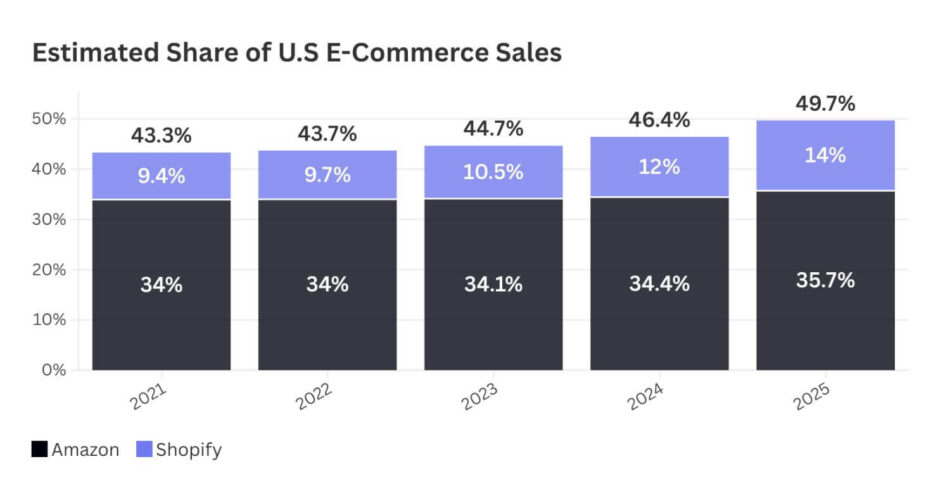
In a significant development for the e-commerce landscape, Amazon and Shopify together now account for approximately 50% of the U.S. e-commerce market. This remarkable statistic, derived from estimates by Marketplace Pulse, highlights the growing dominance of these two platforms in the online retail space. As of 2025, Amazon generated roughly $440 billion in U.S. sales, which translates to a 35.7% share of the overall $1.2 trillion U.S. e-commerce market. Shopify, on the other hand, reported a 14% market share, up from 12% the previous year, marking its second public disclosure of such figures.
Understanding the Market Shares
The combined market share of Amazon and Shopify stands at 49.7%, with Amazon’s figure encompassing both its retail and marketplace operations. Shopify’s share is based on the aggregated sales from millions of independent merchant storefronts. This marks a significant increase from 2021, when the two platforms held an estimated 43% of the market. The gradual closing of this gap over the years has accelerated in the last two years, as both companies have experienced compounded growth in a maturing market.
Amazon’s Market Position
Amazon’s marketplace serves as a crucial infrastructure for sellers, although shoppers primarily interact with Amazon itself rather than the individual sellers behind the products. This distinction is vital in understanding Amazon’s market presence. The company has established itself as a go-to destination for online shoppers, which is reflected in its substantial market share.
Shopify’s Unique Model
Conversely, Shopify operates under a different model. It does not function as a single shopping destination. Instead, it provides a platform for millions of independent merchants to create their own storefronts, manage customer relationships, and maintain brand identities. This decentralized approach allows merchants to sell directly to consumers who visit their individual websites. The recent public acknowledgment of Shopify’s market share signifies a shift in how the industry perceives the aggregation of merchant sales as a valid measure of market presence.
Growth Metrics and Comparisons
Shopify’s global Gross Merchandise Volume (GMV) reached $378 billion, which is now 66% of Amazon’s third-party marketplace GMV of $575 billion. This figure has seen a notable increase from 40% in 2020 and 25% in 2018, indicating Shopify’s robust growth trajectory. The two companies represent different approaches to online commerce, with Amazon focusing on a centralized marketplace and Shopify emphasizing decentralized infrastructure.
Competitive Landscape in U.S. E-Commerce
While Amazon and Shopify dominate the e-commerce space, the remaining half of the market is increasingly competitive. Walmart remains a significant player, serving as the only genuine competitor to Amazon at scale. However, Walmart’s marketplace, estimated at roughly $10 billion in GMV, is still a fraction of Amazon’s volume. Other notable players include:
- eBay: With a reported U.S. GMV of $39.1 billion in 2025, eBay has found its footing by focusing on enthusiasts and collectors rather than competing in the new-in-season goods market.
- TikTok Shop: Having reached an estimated $15.1 billion in U.S. GMV in 2025, TikTok Shop has demonstrated genuine scale in its second full year, although it remains a rounding error compared to the leaders.
- Temu and Shein: These brands occupy the ultra-low-price segment, although their previously held advantages have been structurally eroded.
- Target: Target’s marketplace has yet to achieve meaningful scale in the competitive e-commerce environment.
Market Dynamics and Future Outlook
The U.S. e-commerce landscape has quietly organized itself around the two dominant models: centralized marketplaces and decentralized infrastructures. As both Amazon and Shopify continue to grow, the space between them is where other players are making their case. The competition is fierce, and companies must adapt to the evolving market dynamics to remain relevant.
Implications for Businesses
For businesses operating in the e-commerce space, understanding the dynamics between Amazon and Shopify is crucial. Each platform offers unique advantages and challenges. Companies need to assess their strategies based on their target audience, product offerings, and brand identity. For instance, businesses looking to maintain direct relationships with customers may find Shopify’s model more appealing, while those seeking to leverage a vast existing customer base may prefer Amazon’s marketplace.
Strategies for Success
To thrive in this competitive landscape, businesses should consider the following strategies:
- Diversify Sales Channels: Companies should not rely solely on one platform. Instead, they should explore multiple sales channels, including their own websites, Amazon, and Shopify, to maximize reach.
- Focus on Customer Experience: Regardless of the platform, providing an exceptional customer experience should be a priority. This includes efficient shipping, responsive customer service, and a user-friendly interface.
- Leverage Data Analytics: Utilizing data analytics can provide valuable insights into consumer behavior, helping businesses make informed decisions regarding inventory, marketing strategies, and pricing.
- Invest in Brand Identity: For businesses on Shopify, establishing a strong brand identity is crucial. This can help differentiate them from competitors and foster customer loyalty.
- Optimize for Mobile: With a growing number of consumers shopping on mobile devices, ensuring that online stores are optimized for mobile use is essential for capturing sales.
Conclusion
In summary, the combined market share of Amazon and Shopify has reached a significant milestone, accounting for nearly half of the U.S. e-commerce market. As both companies continue to grow, they exemplify different approaches to online commerce, shaping the future of the industry. Businesses must navigate this evolving landscape strategically, leveraging the strengths of each platform while remaining adaptable to changing consumer preferences and market dynamics.
Note: The evolution of e-commerce is ongoing, and businesses must stay informed and agile to succeed in this competitive environment.
Frequently Asked Questions
Amazon and Shopify together account for approximately 50% of U.S. e-commerce, with Amazon holding a 35.7% share and Shopify a 14% share.
Shopify’s market share has increased from 12% in 2024 to 14% in 2025, reflecting its growth and acceptance in the e-commerce market.
Businesses should diversify sales channels, focus on customer experience, leverage data analytics, invest in brand identity, and optimize for mobile to succeed in the competitive e-commerce environment.
Call To Action
If you are looking to enhance your e-commerce strategy and leverage the power of platforms like Amazon and Shopify, contact us today to explore tailored solutions for your business.
[np_contact_btn]