
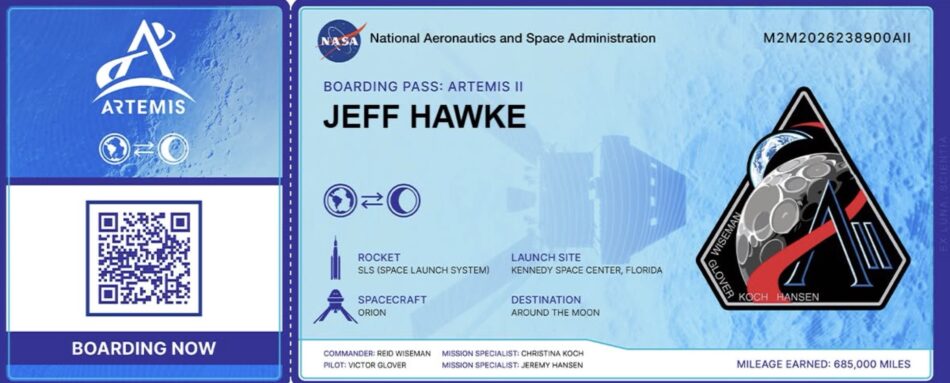
Send Your Name Around the Moon!
In an exciting initiative by NASA, individuals now have the unique opportunity to send their names around the Moon as part of the Artemis II mission. This mission represents a significant milestone in space exploration, aiming to return humans to lunar orbit and prepare for future missions to Mars. With the chance to be included on a boarding pass that will travel aboard the Orion spacecraft, this initiative captures the imagination of space enthusiasts and the general public alike.
The Artemis II Mission
The Artemis II mission is set to be the first crewed flight under NASA’s Artemis campaign. Scheduled for launch no later than April 2026, this mission will see four astronauts embark on a journey around the Moon. The crew consists of:
- Reid Wiseman – Commander
- Victor Glover – Pilot
- Christina Koch – Mission Specialist
- Jeremy Hansen – Mission Specialist from the Canadian Space Agency (CSA)
This mission is not just a journey around the Moon; it is a crucial step towards establishing a sustainable human presence on the lunar surface and preparing for future crewed missions to Mars.
What to Expect During the Mission
The Artemis II mission will last approximately 10 days and will launch from Launch Complex 39 at NASA’s Kennedy Space Center in Florida. During the initial phase of the mission, the crew will conduct system checkouts of the Orion spacecraft and perform manual handling tests near Earth. This will take place over the first two days before the crew heads towards the Moon.
The spacecraft will execute a translunar injection burn, which will propel it out of Earth’s orbit and set a course for the Moon. The journey will take approximately four days, during which the crew will fly around the far side of the Moon in a figure-eight pattern, extending more than 230,000 miles from Earth. At its maximum distance, the crew will be about 4,600 miles beyond the Moon, allowing them to evaluate spacecraft systems and gather valuable data.
Scientific Goals and Payloads
Artemis II is designed to advance our understanding of space and human health. Several scientific payloads will accompany the mission, aimed at expanding knowledge about:
- Space radiation
- Human health and behavior in space
- Space communications
The insights gained from these experiments will be instrumental in shaping future exploration efforts, particularly as NASA prepares for long-duration missions beyond low Earth orbit.
How to Participate: Send Your Name
One of the most engaging aspects of the Artemis II mission is the opportunity for the public to participate by sending their names along for the journey. By submitting your name through the designated NASA webpage, you will receive a virtual boarding pass, and your name will be included on an SD card that travels aboard the Orion spacecraft. This initiative not only fosters public interest in space exploration but also allows individuals to feel a personal connection to this historic mission.
To submit your name for a boarding pass for the Artemis II mission, visit the official NASA website and follow the instructions provided. This is a unique chance to be part of a monumental event in space history.
The Legacy of Space Exploration
The Artemis II mission is a continuation of humanity’s quest to explore the cosmos, following in the footsteps of the Apollo missions that first landed humans on the Moon. The mission aims to build a sustainable presence on the Moon, which will serve as a launchpad for future missions to Mars and beyond. The Artemis program represents a new era of exploration, focusing on international collaboration and the use of innovative technologies.
Historical Context: Jeff Hawke and the Moon Landing
Interestingly, the Jeff Hawke Fan Club has nominated their comic strip hero, Jeff Hawke, to be “aboard” the Artemis II mission. Created by Sydney Jordan in 1959, the character predicted the date of the first Moon landing, showcasing the intersection of popular culture and space exploration. This whimsical nod to history highlights how comic art has often reflected and inspired public interest in space travel.
Future Missions and Exploration Goals
NASA’s Artemis program is not just about returning to the Moon; it is part of a broader strategy to prepare for future exploration of Mars. The lessons learned from Artemis II and subsequent missions will inform the design and execution of crewed missions to the Red Planet. Key goals include:
- Understanding the effects of long-duration spaceflight on human health
- Developing technologies for sustainable living on other planets
- Conducting scientific research that can only be performed in space
As we look towards the future, the Artemis program will serve as a critical stepping stone in our journey to explore Mars and beyond.
Frequently Asked Questions
You can send your name by visiting the official NASA webpage dedicated to the Artemis II mission and submitting your name for a virtual boarding pass. Your name will be included on an SD card that travels aboard the Orion spacecraft.
The Artemis II mission aims to test NASA’s deep space capabilities with a crewed flight around the Moon. It will help prepare for future crewed missions to the lunar surface and eventually to Mars.
The Artemis II mission is scheduled to launch no later than April 2026 from NASA’s Kennedy Space Center in Florida.
Call To Action
Don’t miss your chance to be a part of history! Submit your name for the Artemis II mission today and join the journey around the Moon. This is a unique opportunity to engage with space exploration and inspire future generations.
[np_contact_btn]
Note: The Artemis II mission represents a significant advancement in space exploration, allowing individuals to connect with this historic journey. By participating, you become part of a legacy that aims to push the boundaries of human exploration.