Top Companies in the Web Application Firewall Market – Imperva, Datadog Inc., Akamai Technologies Inc., F5 Networks
- Identify the leading players shaping the Web Application Firewall Market with innovative security solutions.
- Understand strategic approaches of top companies integrating AI and cloud security in application firewalls.
- Explore how enterprises benefit from scalable, multi-cloud WAF deployments to mitigate evolving cyber threats.
- Gain insights into market dynamics, including competitive positioning, investment trends, and technology advancements.
The Web Application Firewall Market has emerged as a critical segment within the cybersecurity landscape, driven by the increasing reliance on web applications for digital services, e-commerce, and cloud operations. As cyber threats become more sophisticated, organizations across industries such as banking, healthcare, retail, and government are prioritizing advanced WAF solutions to safeguard their digital assets.
Leading companies like Imperva, Akamai Technologies, and F5 Networks are innovating rapidly by integrating artificial intelligence, machine learning, and cloud-native capabilities into their WAF offerings. This article provides a comprehensive overview of the top players in the market, their strategic approaches, and how their solutions address the complex challenges of modern web security.
Continue Reading
What Is a Web Application Firewall and Why Is It Essential?
A web application firewall (WAF) is a security solution designed to monitor, filter, and block malicious HTTP/HTTPS traffic targeting web applications. It protects against common cyber threats such as SQL injection, cross-site scripting (XSS), distributed denial-of-service (DDoS) attacks, and bot-driven exploits. WAFs are essential for maintaining the integrity, availability, and confidentiality of web applications in an increasingly digital and interconnected world.
Who Are the Leading Companies in the Web Application Firewall Market?
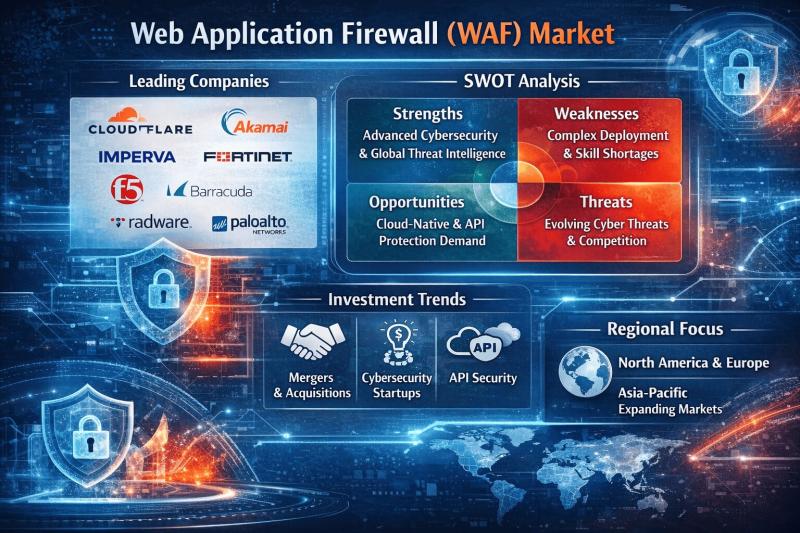
The WAF market is highly competitive, with established cybersecurity firms and emerging technology providers competing to deliver innovative, scalable, and efficient solutions. Here are the top companies dominating this space:
1. Imperva
Imperva is renowned for its specialized focus on application security and data protection. Its advanced WAF solutions protect web applications, APIs, and databases against sophisticated cyber threats. Imperva’s strategy emphasizes continuous innovation in threat detection technologies and behavioral analytics, enabling real-time identification of anomalous activities. The company’s strong enterprise customer base and expertise in application-layer security position it as a market leader.
2. Akamai Technologies
Akamai leverages its extensive global edge network to deliver integrated WAF capabilities combined with content delivery, bot management, and API protection. Its approach focuses on mitigating threats close to their source, reducing latency and improving security efficacy. Akamai’s long-standing relationships with large enterprises and government agencies provide a robust market presence.
3. F5 Networks
F5 Networks specializes in application delivery and security technologies, offering WAF solutions tailored for hybrid and multi-cloud environments. The company’s acquisition-driven expansion has enhanced its portfolio with cloud-native security features and traffic management capabilities. F5’s integrated security approach supports enterprises in securing complex infrastructures while maintaining performance.
4. Cloudflare
Cloudflare stands out with its cloud-native WAF integrated into a global content delivery network (CDN). Its strategy prioritizes scalability and performance, delivering automated security responses powered by real-time threat intelligence. Cloudflare’s developer ecosystem and infrastructure enable rapid deployment and continuous protection against emerging threats.
5. Fortinet
Fortinet integrates WAF solutions within its broader cybersecurity platform, Fortinet Security Fabric, which includes network security, endpoint protection, and threat intelligence. This unified architecture simplifies deployment and management for enterprises. Fortinet’s global partner network accelerates adoption and supports diverse customer needs.
6. Barracuda Networks
Barracuda Networks targets small and medium-sized enterprises with cost-effective and scalable WAF solutions. Offering both cloud-based and appliance options, Barracuda emphasizes ease of use and strong threat protection, making it a preferred choice for mid-market organizations seeking affordable security without complexity.
7. Radware
Radware combines WAF with bot mitigation and DDoS protection, utilizing behavioral analytics and machine learning for automated threat detection. Its solutions cater to organizations requiring high-performance security for large-scale digital platforms. Radware’s global security centers facilitate rapid incident response and threat intelligence sharing.
8. Palo Alto Networks
Palo Alto Networks integrates WAF within its comprehensive cloud security platform, focusing on AI-driven threat prevention and automated security orchestration. Its products are widely adopted by enterprises operating in multi-cloud environments. The company’s research capabilities and global cybersecurity expertise reinforce its leadership position.
How Are These Companies Innovating in the WAF Market?
Innovation in the web application firewall industry is driven by the need to counter increasingly sophisticated cyber threats and the growing complexity of IT environments. Key innovation trends include:
- Artificial intelligence and machine learning integration for adaptive threat detection and automated response.
- Cloud-native and edge computing architectures to enhance scalability and reduce latency.
- Comprehensive security platforms that combine WAF with bot management, API protection, and DDoS mitigation.
- Improved usability and policy management tools to reduce false positives and simplify deployment.
- Support for hybrid and multi-cloud environments to address diverse infrastructure needs.
What Are the Market Dynamics and Growth Drivers?
The WAF market growth is fueled by several factors:
- Increasing adoption of web applications and APIs across industries.
- Rising frequency and sophistication of cyberattacks targeting application layers.
- Regulatory compliance requirements mandating robust application security.
- Shift towards cloud computing and digital transformation initiatives.
- Growing awareness of cybersecurity risks among enterprises.
Challenges and Risks in Deploying Web Application Firewalls
Despite technological advances, organizations face challenges when implementing WAF solutions:
- Complexity in configuring and managing security policies can lead to false positives or missed threats.
- Performance impacts if WAFs are not properly optimized for high-traffic environments.
- Integration difficulties with existing security infrastructure and cloud platforms.
- Cost considerations, especially for small and medium-sized enterprises.
- Keeping pace with rapidly evolving attack vectors and threat landscapes.
How Can Businesses Choose the Right WAF Solution?
Selecting an appropriate web application firewall depends on multiple factors:
- Security requirements: Assess the types of threats and compliance mandates relevant to your industry.
- Deployment model: Decide between cloud-based, on-premises, or hybrid WAF solutions based on infrastructure.
- Scalability: Ensure the WAF can handle current and future traffic volumes without performance degradation.
- Integration: Consider compatibility with existing security tools and cloud platforms.
- Cost and support: Evaluate total cost of ownership and vendor support capabilities.
Future Outlook for the Web Application Firewall Market
The future of WAFs is closely tied to advancements in cybersecurity technologies and evolving enterprise needs. We expect:
- Greater adoption of AI-driven automated threat detection and response.
- Expansion of WAF capabilities to cover emerging technologies such as IoT and edge computing.
- Increased focus on user experience with simplified management and reduced false positives.
- More integrated security platforms combining WAF with zero trust and cloud security frameworks.
- Continued consolidation in the market through strategic acquisitions and partnerships.
Summary of Strategic Approaches by Top Companies
Leading vendors differentiate themselves through unique strategies:
- Imperva prioritizes advanced behavioral analytics and enterprise-grade protection.
- Akamai Technologies leverages edge computing and global infrastructure for threat mitigation.
- F5 Networks focuses on hybrid cloud security and traffic management integration.
- Cloudflare emphasizes cloud-native scalability and real-time automated defenses.
- Fortinet offers unified security architecture simplifying enterprise deployments.
- Barracuda Networks targets affordability and ease of use for mid-market organizations.
- Radware combines high-performance security with automated threat intelligence.
- Palo Alto Networks integrates AI and cloud security orchestration for multi-cloud environments.
Frequently Asked Questions
Call To Action
Discover how integrating advanced web application firewall solutions from industry leaders can enhance your organization’s cybersecurity posture and ensure resilient protection against evolving threats. Contact us today to explore tailored WAF strategies that align with your business goals.
Note: Provide a strategic conclusion reinforcing long-term business impact and keyword relevance.