
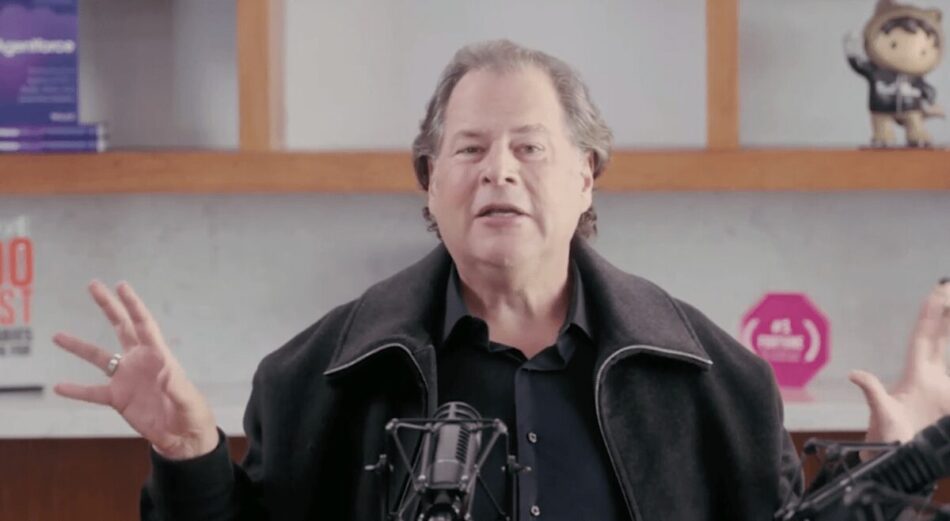
Salesforce CEO Marc Benioff: This Isn’t Our First SaaSpocalypse
- Salesforce’s recent earnings report demonstrates resilience amid fears of AI disruption.
- The company is investing heavily in AI, introducing new metrics to measure performance.
- Benioff’s strategic communication emphasizes the ongoing relevance of SaaS in a changing landscape.
In a rapidly evolving technological landscape, Salesforce CEO Marc Benioff has addressed the challenges posed by the rise of artificial intelligence (AI) and the concept of a “SaaSpocalypse.” During a recent earnings call, he reassured investors that the company remains robust, despite concerns about the future of software-as-a-service (SaaS) models. With Salesforce reporting impressive revenue growth and strategic initiatives, Benioff’s insights provide valuable lessons for businesses navigating similar transitions.
The SaaS industry is currently facing scrutiny as AI technologies advance, leading to fears that traditional business models may become obsolete. Benioff’s proactive approach highlights the importance of adaptability and innovation in maintaining a competitive edge. This article explores Salesforce’s recent performance, strategic initiatives, and the implications for the broader SaaS landscape.
Continue Reading
Salesforce’s Strong Financial Performance
Salesforce recently announced its fourth-quarter earnings, showcasing a solid revenue of $10.7 billion, reflecting a 13% increase year-over-year. For the fiscal year, the company reported total revenue of $41.5 billion, marking a 10% growth compared to the previous year. This growth was significantly bolstered by the acquisition of Informatica, a data management company, for $8 billion in May.
Key Financial Metrics
- Net income reached $7.46 billion.
- Projected revenue for the upcoming year is between $45.8 billion and $46.2 billion, indicating a 10% to 11% increase.
- The remaining performance obligation (RPO) stands at over $72 billion, reflecting revenue under contract that has yet to be recognized.
These figures illustrate Salesforce’s financial resilience, even amidst growing concerns about the future of SaaS companies in light of AI advancements. However, the earnings call revealed a palpable tension regarding the potential impact of AI agents on the traditional SaaS business model.
The SaaSpocalypse: Understanding the Threat
The term “SaaSpocalypse” has emerged within the tech community to describe the fear that AI technologies could disrupt the established SaaS model, particularly the per-employee-seat pricing structure. Investors have expressed concerns that as AI agents become more capable, the demand for traditional software solutions may decline.
Benioff’s Perspective on the SaaSpocalypse
During the earnings call, Marc Benioff addressed the concept of the SaaSpocalypse directly, stating, “You’ve heard about the SaaSpocalypse? And it isn’t our first. We’ve had a few of them.” His comments underscored the cyclical nature of technological disruption and the importance of resilience in the face of change.
Benioff further emphasized that if a SaaSpocalypse were to occur, it would likely be overshadowed by the continued adoption of SaaS solutions, which are becoming increasingly integrated with AI capabilities. He noted, “There are a lot of companies using a lot of SaaS because it just got better with agents.”
Strategic Initiatives to Combat Concerns
In response to investor concerns, Salesforce implemented several strategic initiatives aimed at reinforcing its market position and showcasing the value of its offerings. These initiatives included a significant increase in dividends and a robust share buyback program.
Dividend Increase and Share Buyback Program
- Salesforce increased its dividend by nearly 6% to $0.44 per share.
- The company launched a new $50 billion share buyback program, which serves to bolster shareholder confidence.
These financial maneuvers not only provide immediate returns to shareholders but also signal Salesforce’s commitment to maintaining a strong financial foundation in an uncertain market.
Revamping the Earnings Call
Salesforce’s earnings call took a unique approach this quarter, blending traditional financial reporting with engaging customer testimonials. Benioff interviewed three prominent Salesforce customers, including the CEOs of SharkNinja, Wyndham Hotels and Resorts, and SaaStr, to highlight the effectiveness of Salesforce’s new AI agent products.
Customer Testimonials and Product Validation
The inclusion of customer testimonials served to validate Salesforce’s offerings and demonstrate the real-world impact of its AI capabilities. Each CEO expressed enthusiasm for the company’s new agentic options, reinforcing the message that Salesforce is at the forefront of AI integration in the SaaS space.
Introduction of Agentic Work Units (AWU)
Another significant development from Salesforce is the introduction of a new metric known as agentic work units (AWU). This metric aims to quantify the actual work completed by AI agents, moving beyond traditional token counts.
Understanding Agentic Work Units
AWU is designed to measure meaningful outputs from AI agents, such as when an agent completes a task or updates a record. Salesforce president and CMO Patrick Stokes explained, “You can ask it a question and it can write you a poem, but that’s not really all that valuable in the enterprise world.” The focus on AWU underscores Salesforce’s commitment to delivering tangible business value through its AI solutions.
Architectural Vision for the Future
Salesforce also presented its vision for the future of SaaS and AI integration during the earnings call. The company envisions a landscape where SaaS providers like Salesforce dominate the tech stack, while AI model makers operate as commoditized engines beneath the surface.
Countering Competitive Threats
This architectural vision serves as a direct counter to the competitive threat posed by OpenAI’s recent enterprise agent, Frontier. OpenAI’s model positions itself at the top of the stack, with traditional SaaS providers relegated to a lower status. By articulating its vision, Salesforce aims to reassure investors of its strategic positioning in an evolving market.
Investor Sentiment and Market Reactions
Despite the proactive measures taken by Salesforce, investor sentiment remains cautious. The broader SaaS market has experienced significant volatility, with many companies facing sell-offs amid fears of AI disruption.
Market Trends and Future Outlook
As the landscape continues to shift, Salesforce’s ability to adapt and innovate will be critical in maintaining investor confidence. The company’s strong financial performance, coupled with its strategic initiatives, positions it well to navigate the challenges ahead.
Frequently Asked Questions
The SaaSpocalypse refers to concerns that advancements in AI could disrupt traditional SaaS business models, particularly the per-employee-seat pricing structure.
Salesforce is addressing investor concerns by increasing dividends, launching a significant share buyback program, and showcasing customer testimonials to validate its AI capabilities.
Agentic work units (AWU) are a new metric introduced by Salesforce to measure the actual work completed by AI agents, focusing on meaningful outputs rather than just token counts.
Call To Action
Explore how your business can leverage AI and SaaS solutions to drive growth and innovation in a rapidly changing market.
Note: Provide a strategic conclusion reinforcing long-term business impact and keyword relevance.