Robot plays tennis with humans in real time
- Real-time AI enables robots to react instantly to human tennis shots without scripts.
- Advanced motion tracking and millisecond reaction times allow sustained rallies with humans.
- Training uses motion fragments to simulate complex human tennis movements efficiently.
- Innovations in humanoid robotics demonstrate scalable applications in sports and interactive AI.
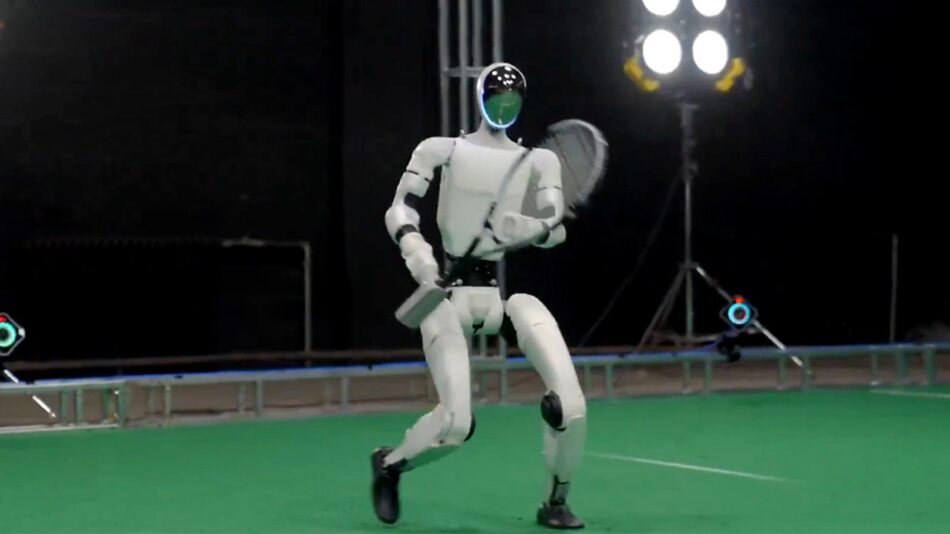
The emergence of a humanoid robot capable of playing tennis with humans in real time marks a significant milestone in artificial intelligence and robotics. Unlike traditional robots that rely on pre-programmed routines or remote control, this robot dynamically reacts to a human opponent’s shots, adjusting its position and swing instantaneously. This breakthrough is powered by an AI system trained on real player movements, enabling it to sustain rallies with impressive accuracy and speed.
Developed by Galbot Robotics and running on the Unitree G1 platform, this compact robot stands about four feet tall and demonstrates full-body coordination and rapid decision-making. The innovative training method, which uses motion fragments instead of full match recordings, allows the AI to learn complex tennis dynamics efficiently. This advancement not only showcases the potential of real-time AI reactions in sports robotics but also opens doors for future applications in interactive robotic systems and human-AI collaboration.
Continue Reading
How does the robot play tennis with humans in real time?
The robot plays tennis with humans in real time by utilizing a sophisticated AI system called LATENT, which processes visual and motion data instantly to react to a human opponent’s shots. Unlike scripted robots, this humanoid robot operates autonomously without remote control, tracking the ball’s trajectory, speed, and spin to position itself and return shots effectively.
Its AI is capable of millisecond-level reaction times, allowing it to keep up with the fast pace of tennis where balls can reach speeds of up to 67 miles per hour. The robot’s compact, human-like frame measuring about four feet tall provides it with agility and balance, enabling it to move fluidly across the court and adjust to unpredictable shot angles during rallies.
Key technologies enabling real-time tennis play
- Computer vision systems track the ball and player movements continuously.
- Machine learning algorithms predict ball trajectories and optimize response strategies.
- High-precision actuators and sensors provide rapid and coordinated physical movement.
- Real-time data processing ensures immediate reaction without lag.
What makes this tennis robot different from previous robotic players?
Most athletic robots seen before perform pre-programmed actions or rely on remote control, limiting their ability to adapt during live play. This robot breaks new ground by reacting dynamically to a human opponent’s shots with no scripts involved. It can adjust its position and swing in response to changing ball trajectories and speeds, enabling it to sustain rallies with humans in a way that mimics real competitive play.
The robot’s ability to integrate full-body coordination and rapid decision-making in a compact humanoid form is a major advancement. Its AI system can handle the complexities of tennis, such as split-second racket contact and continuous movement across a large court, which were previously difficult to replicate in robotics.
Advantages over scripted robotic tennis players
- Adaptive play based on live input rather than fixed routines.
- Improved accuracy and timing in returning shots.
- Enhanced physical balance and agility for dynamic court coverage.
- Capability to handle unpredictable and complex shot patterns.
How was the AI trained to play tennis?
Training a robot to play tennis is complex due to the high-speed dynamics and intricate movements involved. Instead of recording entire matches, the researchers used a novel approach by focusing on small motion fragments. This method captures essential segments of player movements, such as swings, footwork, and ball contact, which the AI then learns to replicate and combine during play.
This fragment-based training allows the AI to generalize from partial data and adapt to a wide range of tennis scenarios. It reduces the need for enormous datasets while still enabling the robot to perform complex, coordinated actions in real time.
Benefits of motion fragment training
- Efficient learning from limited but high-quality data segments.
- Ability to synthesize new movement sequences dynamically.
- Improved generalization to unpredictable gameplay situations.
- Reduced training time compared to full match recording methods.
What are the business and technological implications of this innovation?
This breakthrough in robotic tennis players demonstrates significant potential for expanding AI and robotics in sports training, entertainment, and human-machine interaction. The ability to create robots that can engage in real-time physical competition with humans opens new markets for interactive sports robots, coaching aids, and competitive exhibitions.
Technologically, the success of this robot illustrates advances in real-time AI processing, machine learning for motion prediction, and compact humanoid robotics. These innovations can be scaled and adapted to other sports or applications requiring rapid physical interaction and decision-making.
Strategic business opportunities
- Sports training devices that provide real-time feedback and challenge athletes.
- Entertainment and exhibition robotics for fan engagement and marketing.
- Research platforms for advancing AI-human physical collaboration.
- Potential integration with wearable tech and smart sports equipment.
Challenges and risks
- High development and production costs for advanced humanoid robots.
- Ensuring safety and compliance in human-robot physical interaction.
- Technical scalability to different sports and environments.
- Maintaining AI adaptability against diverse human playing styles.
What does the future hold for AI-powered sports robots?
The success of this tennis-playing robot signals a future where AI-powered robots can participate alongside humans in various sports and physical activities. Continuous improvements in robotic agility, AI decision-making, and sensor technologies will enable more sophisticated and versatile sports robots.
Future developments may include robots that can coach players by analyzing performance in real time, assist in rehabilitation through interactive exercises, or even compete in mixed human-robot sports leagues. The integration of AI with robotics in sports is poised to transform training methodologies, fan experiences, and the broader sports industry.
Frequently Asked Questions
Call To Action
Explore how integrating real-time AI and robotics can revolutionize your sports technology solutions and enhance human-machine collaboration in dynamic environments.
Note: Provide a strategic conclusion reinforcing long-term business impact and keyword relevance.